Old Town
Wi-Fi and cabling in stone houses: structured cabling for the Old Town
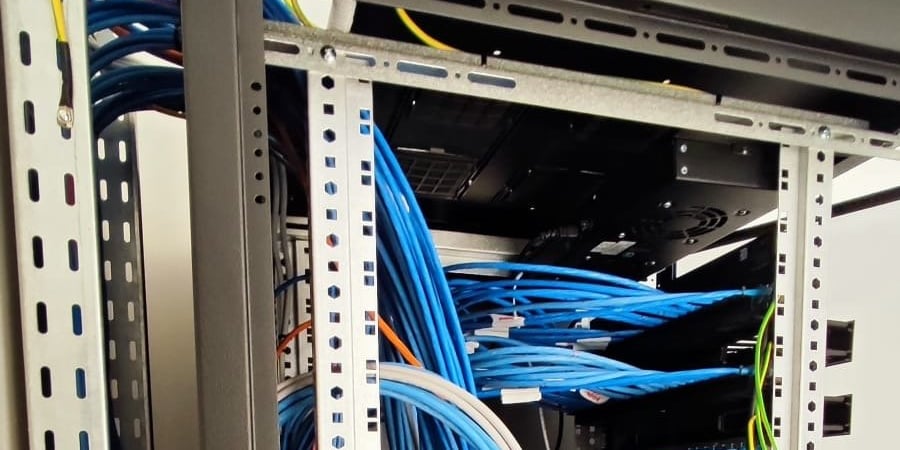
A router by the front door of a stone house in the Old Town (Stari grad) can leave the top floor with a weak signal or none. The lasting fix is not a stronger router but a cable: structured cabling (strukturno kabliranje) that brings the network to each floor, where a small access point (pristupna točka) turns it back into Wi-Fi. Below: why stone gets in the way, what a cabled network looks like, where cables can run and which rules apply inside the walls.
Why does Wi-Fi struggle in a stone house?
Wi-Fi is a radio signal, and thick masonry absorbs and reflects it. In a stone house the rooms are also stacked on top of each other, so the signal has to pass through floors as well as walls. One router, however strong, rarely covers every floor; access points connected by cable do.
The shape of the houses explains a lot. After the earthquake of 1667 the Republic of Ragusa set one layout for all future houses by law, and the 17th-century houses along Stradun still share it: a shop on the ground floor, living quarters above and the kitchen in the loft, to limit the spread of fire (Stradun on Wikipedia). Such a house grows upwards, so a router by the door has to reach the top floor through every floor in between.
The walls are heavy too. Between 2000 and early 2021 the Institute for the Restoration of Dubrovnik (Zavod za obnovu Dubrovnika) strengthened 45 building blocks in the historic core, more than 200 buildings, by grouting stone walls whose voids can reach 20% of their volume and tying each block with tensioned steel at floor level (the Institute’s account of the seismic works). Every wall of dense, grouted stone weakens the signal again.
Repeaters and mesh kits help in a small flat, but each wireless hop crosses the same walls and loses speed. A cabled connection is steadier and faster, which is why the low-voltage side of an installation (elektroinstalacije slabe struje: data, TV and signal cabling) deserves the same planning as the power side.
What does structured cabling look like in a house like this?
Structured cabling means every network cable starts at one central point, a small network rack (rack ormar) or wall cabinet, and runs to a socket or an access point, labelled at both ends. The rack holds the router, a patch panel and a switch (preklopnik), so any line can be traced and changed without guesswork.
| Part | What it does | Where it usually goes |
|---|---|---|
| Network rack or wall cabinet | Holds the router, the patch panel and the switch | A cupboard, a store room or under the stairs, near where the internet line comes in |
| Patch panel | The end point of every cable, each port numbered to match its socket | In the rack |
| Switch | Links every cable to the router; a PoE (power over Ethernet) switch also powers access points and cameras through the cable | In the rack |
| Access point | Turns the cabled network back into Wi-Fi for one floor or one apartment | On a ceiling or high on a wall, as a rule one per floor |
| Multiswitch | Shares one satellite or aerial signal among several receivers (satellite and TV distribution, SAT i TV razvod) | In the rack or a wall cabinet |
Every cable is labelled at the socket and at the patch panel. In a holiday rental (apartman za iznajmljivanje), that turns a guest’s complaint about the second-floor Wi-Fi into a short check instead of a long search. Cameras and card readers can run over the same cabling, so CCTV and access control are best planned with the network, not after it.
Where can the cables run without harming the building?
Along the routes the house already offers: floors and ceilings that are being renewed, stairwells, existing service shafts, built-in joinery and the space behind skirting. Where a short run has to show, it goes in neat trunking. The cable routes (kabelske trase) are agreed room by room with the owner before the first cable is pulled.
The reason is the masonry. A wall that has been grouted and tied into its block is part of the structure of the whole block, so routes in these houses tend to follow floors, ceilings and shafts rather than new channels cut into the stone.
New installations stay off the facade. The protection measures for the historic core (zone A of the 2008 register decision, matching the World Heritage area) do not permit new installation elements on house facades, naming satellite dishes, external air-conditioning units and inappropriately executed lighting among them, and require infrastructure to be laid underground (World Heritage management plan for the Old Town, 2021–2026). A cable between floors therefore runs inside the house. For television, ask the conservation department (konzervatorski odjel) before planning any dish or aerial; television over the internet connection needs a network point by the TV, not a dish.
Do you need approval to add cabling inside the Old Town?
Possibly, so ask before work starts. Croatia’s cultural-goods law frees some interior works, the replacement and repair of installations among them, from approval in protected ensembles, but not in ensembles on the World Heritage List, and the Old Town is one. The conservation department can tell you what your job needs.
The rule is Article 48 of the Act on the Protection and Preservation of Cultural Goods (Zakon o zaštiti i očuvanju kulturnih dobara). It exempts interior works such as painting, joinery, floors and the replacement and repair of installations in non-listed buildings inside protected ensembles, and its fourth paragraph excludes ensembles on the World Heritage List (Narodne novine 145/2024). Read as published, the exemption does not reach the Old Town, so even replacing an old installation in a flat there is not covered by it. How the department applies that to a small job is for the department to say. Where an approval is needed, the Act gives the Ministry 15 working days from a complete application to decide, and the approval is valid for five years from the day it becomes final.
The office is the Ministry of Culture and Media’s Regional Conservation Service in the city (Područna konzervatorska služba Dubrovnik) at Restićeva 7, which the City’s rules still call the conservation department (Ministry of Culture and Media contacts).
Work on the outside is a separate matter. The City’s Communal Order Decision (Odluka o komunalnom redu) requires the conservation department’s prior approval for all exterior works on a protected building, and in the historic core it bans construction works on facades and exterior parts of buildings from 15 June to 15 September (Službeni glasnik Grada Dubrovnika 12/20). A cable across a facade or a camera by the door counts as exterior work; our guide to facade lighting and cameras covers it. In a building with several owners, work on the common parts, such as the staircase or a shared shaft, also needs the consent of the co-owners (suvlasnici) or the building manager (upravitelj zgrade).
How should a holiday rental or a venue inside the walls be cabled?
Plan one cabled access point per floor or per apartment, a guest network kept apart from the owner’s equipment, and a small labelled rack that also feeds the cameras and the door readers. Do the work before the season, while the house is empty (when to book), and keep the handover notes with the house.
Inside the walls, the network often serves guests rather than residents. Tourist board figures in the carrying-capacity study the City commissioned from the University of Dubrovnik show 1,432 registered accommodation objects with 3,978 beds inside the walls in 2023, against an estimated 1,200 residents; the study also found around 150 restaurants and bars there (summary of the Old Town carrying-capacity study). For guests the network is part of the stay; for a bar or a restaurant it carries the till, the music and the cameras.
- A guest network of its own, kept apart from the recorder, the cameras and the access-control system, so guests’ phones never see the equipment that protects the house.
- One access point per apartment or floor, each on its own cable, so nobody depends on a router two floors away.
- Card readers, keypads and cameras on the same cabling, powered from the switch where they support PoE: see keyless entry for holiday rentals and CCTV at a rental property.
- A UPS (uninterruptible power supply) that keeps the router, the switch and the recorder running through a short power cut.
Getting materials to the door is part of the plan. The historic core is a pedestrian zone in which motor traffic is allowed only with the City’s approval (Communal Order Decision, consolidated text), so unless that approval is in place, cable, a rack and tools are carried in on foot.
At the handover (predaja radova) we explain what was installed, which label belongs to which room and how to use the system; the guide to handover documents worth insisting on lists what to keep. Buying inside the walls? Check the network with the wiring: what an electrical inspection should check. For your own house, network and TV cabling shows what Electro Access installs; send the street, the number of floors and a photo of where the internet line comes in for a written quote (ponuda), after a site visit (pregled objekta) where one is needed.
Quick answers
Is a mesh Wi-Fi kit enough for a stone house?
Sometimes, in a small flat. Mesh units pass the signal from one to the next through the same walls that weakened it, so every wireless hop costs speed. Access points connected by cable avoid that, which is why a cabled access point on each floor is the steadier answer in a tall stone house.
Can network cabling be added to an existing stone house?
As a rule, yes. The easiest moment is a renovation, while floors and ceilings are open; in a finished house the cable follows stairwells, built-in joinery and existing shafts, and a short visible run goes in neat trunking. The route is agreed with you before work starts.
Does cabling inside an Old Town flat need the conservation department's approval?
Ask the conservation department before work starts. Article 48 of the cultural-goods Act exempts the replacement and repair of installations in protected ensembles, but its fourth paragraph leaves out ensembles on the World Heritage List, the Old Town among them, so the exemption cannot be relied on there.
Can a satellite dish go on an Old Town facade?
Not as a new installation: the protection measures for the historic core do not permit new satellite dishes, external air-conditioning units or other new installation elements on house facades. Before planning any dish or aerial, ask the conservation department; for television over the internet, a network point by the TV does the job.