Old Town
Facade lighting and cameras in the Old Town: rope access instead of scaffolding (permits, conservation)
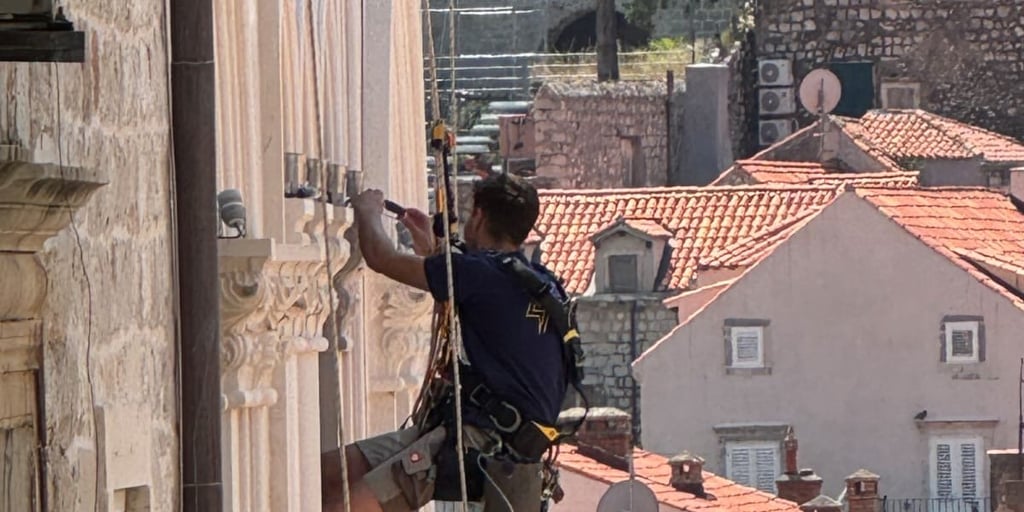
A light on a palace facade (fasada) or a camera over a doorway in the Old Town (Stari grad) is a small job with a large access problem. Rope access (rad na užetu), a form of work at height (visinski radovi), solves the access: the electrician works suspended on ropes, with no scaffold (skela) or access platform (platforma) in the street. It does not solve the paperwork, because the conservation department (konzervatorski odjel) still decides what may go on a protected facade.
What does rope access change for facade work?
It removes the scaffold. The electrician works suspended on two ropes, so nothing is erected in the street, no public surface is leased for a scaffold and the passage stays open. Ropes also reach inner courtyards (unutarnje dvorište), light-wells (svjetlarnik) and narrow streets that scaffolding or an access platform cannot enter.
A scaffold in the street is a project of its own. Using a public surface for scaffolding, hoists or site fencing (occupying public space, zauzimanje javne površine) needs a City approval that sets the location, conditions and duration of the works (Communal Order Decision, consolidated text). A lease contract for the surface follows, for up to three months with the possibility of extension; the scaffold carries a cover printed with an image of the building and, in a street, is marked and lit from dusk to dawn (consolidated text with amendments to 2023). The rent depends on the zone and is paid monthly in advance (Decision on the Lease of Public Surfaces).
Safety rules add their own steps: a scaffold is put up, altered and taken down only under the supervision of a competent person, by workers trained for it (Narodne novine 18/2017). That does not make a scaffold wrong: for long work across a whole facade it may be right. A rope job puts no scaffold in the street, and anything else it needs from the City, such as storing material on a public surface, is checked when the work is planned.
Which approvals still apply when the work is done from ropes?
Those that concern the building. Any work on the exterior of a protected building needs the conservation department’s prior approval, and the summer pause on facade works applies too, whether the facade is reached from a scaffold or from ropes. Rope access changes how a facade is reached, not whether work on it is allowed.
The City’s Communal Order Decision (Odluka o komunalnom redu) puts the duty on the owner: for a building that is a cultural good or lies within the protected ensemble, all works on the exterior need the conservation department’s prior approval, and exterior works without it, or contrary to it, are banned (Službeni glasnik Grada Dubrovnika 12/20). The office is the Ministry of Culture and Media’s Regional Conservation Service (Područna konzervatorska služba Dubrovnik) at Restićeva 7 (Ministry of Culture and Media contacts).
Under the 2024 Act on the Protection and Preservation of Cultural Goods, the document is an approval for interventions on a cultural good (odobrenje za zahvate na kulturnom dobru), still often called prior approval (prethodno odobrenje). The Ministry must decide within 15 working days of a complete application, the approval is valid for five years from the day it becomes final, and the investor must tell the Ministry before work starts so that conservation supervision can take place. Working without the approval, or against it, is a misdemeanour for the investor and the contractor alike, and the works can be stopped (Narodne novine 145/2024).
What may go on a facade at all is set by the protection measures for the core. In zone A, which matches the World Heritage area, they do not permit new installation elements on house facades, naming satellite dishes, external air-conditioning units, advertising panels and inappropriately executed lighting among them, and infrastructure is to be laid underground (World Heritage management plan for the Old Town, 2021–2026). For any light or camera inside the walls, the first question is whether it may go there at all; the conservation department answers it, together with where the cable may run.
In a building with several owners, work on the common parts also needs the consent of the co-owners (suvlasnici) or the building manager (upravitelj zgrade). A camera adds one question, where it may point: positions follow the data-protection rules, with visible signs and no needless filming of the street or the neighbours, as our guide to CCTV at a rental property explains.
Scaffold and ropes side by side, inside the walls:
| What the job involves | Scaffold in the street | Rope access |
|---|---|---|
| Conservation department’s prior approval | Needed | Needed |
| Facade-works ban, 15 June to 15 September | Applies | Applies |
| City approval for using the public surface | Needed | Not for a scaffold; other use of the street checked per job |
| Lease contract for the surface | Up to three months, extendable | No scaffold, so no lease |
| Cover printed with an image of the building | Needed on or in view of a public surface | Not applicable |
| Marking and lights from dusk to dawn | Needed where it occupies a street | Not applicable |
| Safety rules | Put up and taken down under a competent person’s supervision | At least two ropes anchored at both ends, planned rescue, workers trained for it |
| Inner courtyards and light-wells | Often out of reach | Within reach |
When can facade work be done inside the walls?
Outside high summer. In the historic core, construction works on facades and exterior parts of buildings, scaffolding included, are banned from 15 June to 15 September every year. A light or a camera fitted from ropes is exterior work too, so plan it for the months either side and apply for the approval well before.
The ban is in Article 10 of the Communal Order Decision, and the City’s decision on leasing public surfaces repeats it (Službeni glasnik Grada Dubrovnika 12/20); work inside the building is not covered by it. Outside those dates, construction works in the city may run from 07:00 to 22:00, not on Sundays or public holidays, unless another City act says otherwise (consolidated text with amendments to 2023). So: the visit and the approval in autumn or winter, the facade work between 16 September and 14 June, when the weather allows work at height.
How is facade work done safely from ropes?
With two independent rope systems, a working line and a safety line, so that one always secures the other. Croatian rules require at least two ropes anchored at both ends, a harness connected to the safety rope, tools tied to the worker, planned and supervised work and a rescue that can start at once.
The rules are in the Rulebook on safety when using work equipment (Pravilnik o zaštiti na radu pri uporabi radne opreme), which transposes the EU work-equipment directive. The working rope (radno uže) serves for access, descent and support and carries a self-stopping device; the safety rope (zaštitno uže) protects against a fall and carries a fall arrester that follows the worker. Tools are attached to the harness or the seat, the work is planned and supervised so that a worker can be rescued at once, and the workers are trained for the planned work, above all for rescue. A single rope is allowed only where a risk assessment shows that a second would make the work more dangerous (Narodne novine 18/2017).
The same rulebook makes ropes a choice to be justified: rope access may be used where the risk assessment shows the work can be done safely and other, safer work equipment is not justified, and occasional work at height only when the weather does not put the workers at risk. Ropes suit places a scaffold or a platform cannot reach, and jobs too small to justify a scaffold.
The electrician who fits the light or the camera also connects it to the installation, so the fitting and the circuit come from the same team. The rope photos under from the field show the work above the Old Town’s rooftops.
What should you send to plan a facade job?
The address and the building, what you want fitted and where, photos of the facade from the street and from any courtyard, and whether you own the whole building or a part of it. With that, the visit can be arranged, the approval applied for in time and the work kept out of the summer pause.
- Describe the job, with photos, on WhatsApp, by phone on +385 95 506 8145 or through the quote form.
- Site visit (pregled objekta). Where needed, we look at the facade, the roof (krov) or upper floor the ropes are rigged from, and the cable route back to the distribution board (razvodni ormar).
- Approvals. The owner applies for the conservation approval and collects any co-owners’ consent.
- Written quote (ponuda), based on the real scope, with labour and materials listed.
- The work, between 16 September and 14 June, in our site hours (07:00–16:00, Monday to Friday).
- Handover (predaja radova). We explain what was fitted, how it is switched and where the cable runs.
The rope access section shows the facade, roof and courtyard work Electro Access does, and the Old Town section sums up what changes inside the walls. Cabling inside the house as well? See Wi-Fi and cabling in stone houses. Buying? Start with what an electrical inspection should check.
Quick answers
Does rope access avoid the need for conservation approval?
No. The City's rules require the conservation department's prior approval for any work on the exterior of a protected building, however the facade is reached. Ropes replace the scaffold, not the approval.
Can a facade light be fitted in July or August?
Not inside the historic core. Construction works on facades and exterior parts of buildings there are banned from 15 June to 15 September every year, so exterior electrical work, facade lighting included, is scheduled between 16 September and 14 June.
Is rope access always allowed instead of scaffolding?
No. Croatian rules allow rope access where a risk assessment shows the work can be done safely and other, safer work equipment is not justified. Narrow streets, inner courtyards and light-wells, where no scaffold or platform fits, are where ropes come in.
Where may a facade camera point?
At your own entrance, with as little of the street and the neighbours in view as the job allows. Camera positions are planned around the data-protection rules, with visible signs, and the fixing on the facade still needs the conservation department's approval like any other exterior work.
What does the building owner need to arrange?
The conservation approval for the exterior work, the consent of the co-owners or the building manager where common parts are involved, and access to the roof or the upper floor the ropes are rigged from. The written quote then lists the labour and materials.